


The tidy funnel was always a fiction: A typical enterprise purchase involves 13 internal stakeholders and 9 external influencers (Forrester). Now add the AI assistants and agents they’re all consulting, and your carefully crafted customer journey map starts to break down.
Today’s buyers loop between AI answers, AI agents, and trusted humans before your sales team has a chance to weigh in. So, who’s speaking for your brand?
The B2B buyer journey has changed, and smart brands are changing with it. Yet too many B2B marketing teams are still optimizing for clicks.
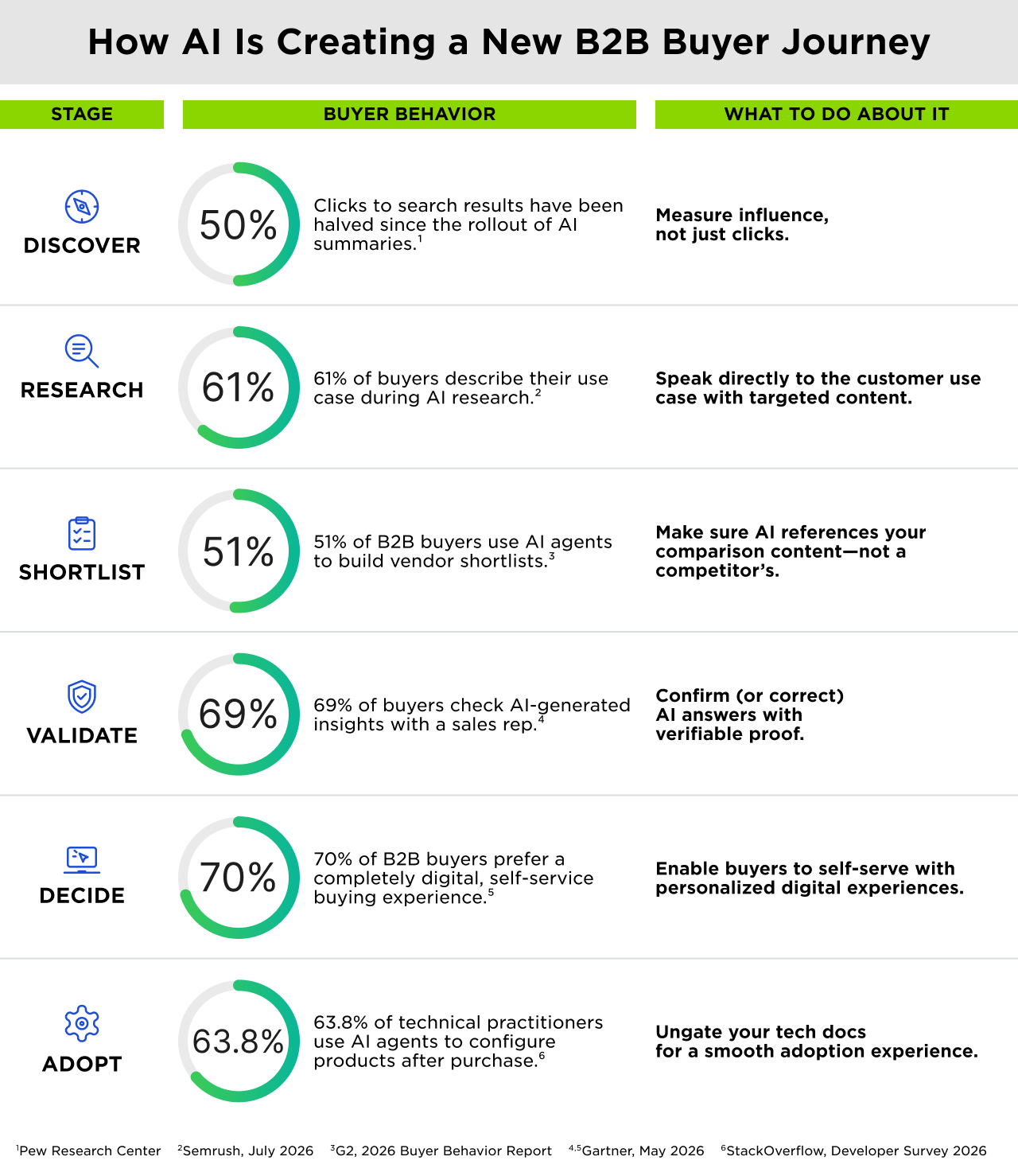
Here’s how the journey looks now, stage by stage.
Discover: Measure Influence, Not Clicks
The dwindling number of referrals from Google search results is one of the most talked-about shifts in the entire buyer journey, because it goes directly against what most B2B marketers were taught to do: measure and optimize for the almighty click. This change was happening before AI, but the rollout of AI Overviews has only accelerated it. According to the Pew Research Center, Google users who see an AI summary are only half as likely to click through to results (8% vs. 15%). In response, entire new disciplines have emerged: AEO (Answer Engine Optimization) and GEO (Generative Engine Optimization), which aim to optimize content for citation by AI search summaries and inside AI chats.
The good news is that AI responds well to many of the same things humans do. So, by following these content best practices, you’re also implementing AEO/GEO:
- Include citations and statistics to boost content visibility by up to 40%. (Generative Engine Optimization)
- Use structured content formats (lists, tables, step-by-step guides), which are 2.5 times more likely to be cited by AI. (GetCite.ai)
- Follow Google’s classic E-E-A-T content quality framework (Experience, Expertise, Authoritativeness, and Trustworthiness).
- Favor specific, concrete detail over vague summaries or marketing speak.
The harder part is changing how teams think about marketing. Optimization is the comfort zone for many B2B marketers. But in the era of waning clicks, we need to guide marketing organizations toward cultivating and measuring influence. To do that, prioritize content that offers value to customers wherever they are (whether that’s on LinkedIn, in the AI Overview, or in an AI chat), then measure signals like AI citation accuracy, branded search volume (a sign that customers are searching your brand name after encountering it in an AI answer), and share of voice.
Research: Address the Use Case
It’s now easier than ever for buyers to find solutions tailored to their specific use case. According to Semrush, 61% of buyers describe their use case during AI research, and 53% take notice of a brand mentioned by AI if it closely matches their use case (versus just 7% who say they’re influenced by brand recognition).
In some cases, buyers are even using the AI-assisted analysis available inside their security or infrastructure tools to show gaps and make recommendations. If you offer content that addresses those problem categories, you win.
Speak directly to buyer needs with content that addresses their use case. In the past, you’d do this so that your brand would show up in Google results. Today, you do it so that AI can find, understand, and recommend you in a way that grabs your customer’s attention. Some tips:
- Be specific: “Securing remote access for hybrid workforces” is better than “Next-generation network performance.” The former is something a buyer might actually type into an AI tool; the latter doesn’t give AI anything to match against.
- Answer buyer questions: This one hasn’t changed. Structure your content around the problems and questions that your buyers type into AI chat.
- Name the tradeoffs: Spell out who your solution is for—and who it’s not. This helps AI recommend you to the right buyers.
- Stay consistent: AI isn’t just looking at your product or use case page. It also pulls from documentation, reviews, and third-party sites. A content governance process that removes outdated content from your site, coupled with a strong brand presence, will serve you well here.
Shortlist: Make Your Specs Machine-Readable
Buyers used to have to compile their own shortlists. Now, 51% of them use AI agents to build vendor shortlists in seconds (G2, 2026 Buyer Behavior Report). Pricing, specs, integrations—anything that a human used to find by combing through your and your competitors’ sites—can now be automatically compiled and served up in a table customized to the individual buyer’s needs.
Now, in addition to making all that info easy to find, you also need to ensure that it’s readable by machines. An agent can’t shortlist what it can’t parse.
But smart marketers go a step further by offering clear, structured comparison content for AI to reference. Yes, comparison pages have been around for a while, and yes, it’s hard to create one that customers will trust. It’s still worth taking the time to develop one for AI summaries to draw from. Otherwise, AI will synthesize an answer from whatever outside sources it can find—including your competitors’ comparison pages.
A final note: G2’s 2026 Buyer Behavior Report suggests that the ease of compiling a shortlist means that it’s now happening earlier in the process than ever before. So make sure you’re investing in the earlier journey stages as well.
Validate: Provide Proof for Humans
We may see a future where AI agents will take the (AI-generated) shortlist, request a quote, go through budget approval, and sign the purchase order on behalf of the enterprise. But for now, humans still make the final decision. While they increasingly prefer the low-friction, self-service buying experience that AI enables, they also want to make sure the AI’s advice is reliable: 69% of buyers prefer to check AI-generated insights with a sales rep (Gartner, May 2026). This is where your experience with trustworthy, resonant content can still shine.
While direct contact and customer ownership are in the sales realm, marketers can add value by creating content that enables the sales process. Provide verifiable proof, such as case studies, third-party data, and expert perspective, that confirms or corrects what AI may have said about your product.
Use a variety of content types to further build credibility. Peer reviews, analyst recognition, project showcases, value calculators, workflow walkthroughs, and “how it was made” stories are examples of valuable proof points that can sway a buyer. These formats may not find their way into AI-cited answers, but they’re crucial for establishing trust with the humans who are still at the heart of the buyer journey.
Decide: Personalize, Personalize, Personalize
One thing that hasn’t changed about the B2B buyer journey is its complexity and the sheer number of people involved. According to Forrester, a typical purchase involves 13 internal stakeholders plus nine external influencers. That’s a lot of people, each with different questions, and your digital experience has to answer them all.
First, identify who’s involved in a typical purchase and what they need to see before they say yes. (Personas are the classic way to do this.) Then, serve up the content, proof points, and next steps most suited to their roles. Sixty-nine percent of B2B buyers prefer a completely digital, self-service buying experience (Gartner, May 2026), so letting site visitors self-identify and access personalized content on their own helps them get answers to their particular questions and meet their specific information needs.
The goal isn’t personalization for its own sake. It’s giving every member of the buying group a self-serve experience that answers the questions they care about.
Adopt: Don’t Gate Your Docs
Congratulations! You made the sale. Your new customer is ready to implement your solution, and to help, they now have access to the gated support portal—but their AI agents don’t.
Why does that matter? Increasingly, technical practitioners are using AI chat for troubleshooting and AI agents for configuration—63.8%, according to StackOverflow’s 2026 Developer Survey. That means AI tools need access to your tech docs, both for generating quick troubleshooting answers and for configuration tasks like writing scripts, setting up integrations, and calling your APIs.
When your docs sit behind a login, AI fills the gap with whatever it can find: outdated forum threads, third-party blog posts, or confident guesses. The risk is that the customer may blame the resulting problems on your product, not their AI. That means a rocky onboarding, more support tickets, and a tougher renewal conversation when their contract ends.
The fix is to provide technical documentation that’s ungated and indexable, with API references in a structured, machine-readable format. Bonus: Ungated docs also serve as a pre-sale asset, letting buyers (and their agents) dig into details and see the quality of your documentation for themselves.
Remember, the sale isn’t the finish line. If your docs aren’t accessible to AI, customers will struggle to succeed with your product.
In Today’s B2B Buyer Journey, Content Dictates How Brands Show Up
Let’s return to the question we asked at the outset: Who’s speaking for your brand? At every stage of the journey, the answer is either your content (if you optimize for visibility) or someone else’s (if you continue optimizing for clicks). Content plays a critical role, whether a buyer consumes it directly, through an AI intermediary, or on any other channel.
Buyers now consult AI at every journey stage, but the answers they get are only as good as the content behind them. When content is specific, structured, consistent, and accessible, you shape the story. When it’s vague, incomplete, outdated, or locked away, someone else tells it for you.
Start by auditing what AI says about your brand today, then close the biggest gap first.