



Hot take: Enterprise marketers may need to pump the brakes on AI adoption. Not stop. Not reverse. Just slow down enough to ask a question that’s getting lost in the rush to deploy custom GPTs: Are our content operations actually ready to support AI-assisted content at scale?
Yes, enterprise marketing teams are under increasing pressure to demonstrate AI progress. Leadership expectations are real, and so is marketers’ own excitement about the potential productivity gains. Teams see custom GPTs as a way to move faster, reduce manual work, and free up time for higher-value thinking. That motivation is valid and powerful, but speed without structure has a tendency to expose cracks.
AI Momentum Is Real—But Confidence Is Lagging
Here’s the tension many marketing leaders are feeling: Momentum is building, but certainty is not. A new global report from programmatic media partner MiQ found that 72% of marketers plan to apply AI in more ways over the next 12 months—yet only 45% feel confident in their ability to apply it successfully.
That gap suggests something deeper than a tooling problem. It points to a readiness issue—specifically, whether organizations have reached a level of content maturity that enables AI-powered output to be deployed, governed, and measured strategically.
In many cases, the rush to experiment with custom GPTs is skipping that assessment. But custom GPTs don’t just generate output on demand. They participate in a broader content system. And like any system component, their outputs inherit the strengths and weaknesses of the strategies, processes, and models that underpin them.
The Promise—and Limitations—of Custom GPTs in Marketing
At Tendo, we’re also bullish on AI’s potential as a marketing accelerator. Custom GPTs—purpose-built AI models that are configured with company-specific context and documentation—are a good example. Teams are already using them to do an array of marketing tasks:
- Writing and adapting email copy
- Generating blog outlines
- Creating derivative content variations
- Optimizing content for search (SEO and GEO)
- Generating metadata and taxonomy
- Personalizing experiences
- Analyzing content performance
- Even generating visuals or code
We’re exploring the technology ourselves for use cases like persona development, content scoring, and content optimization.
But as powerful as GPTs are, they are still tools. They won’t automagically fix gaps in content strategy, structure, or operations. Instead, they can end up amplifying whatever conditions already exist. Marketing leaders who are asking whether AI is “working” may be better served by first figuring out whether the surrounding content environment is ready to absorb and operationalize what it produces.
From Brand Guardrails to Maturity Guardrails
Most organizations already recognize the need for brand guardrails. Brand books, style guides, and messaging frameworks act as micro-level constraints for custom GPTs. They ensure tone, voice, and terminology remain consistent.
But those guardrails only answer one question: Does this content sound like us? They don’t address the macro-level guardrails required for AI-supported content to contribute to strategic goals. Those guardrails are established through content maturity, including:
- Clear alignment between content and business strategy
- Defined content models and architecture
- Governed workflows and ownership
- Measurement and optimization loops
Without these, AI-generated content may be perfectly on-brand yet still ineffective. As Taylor Narewski, Global SMB & Mid-Market Partner Marketing Leader at Cisco, put it:
AI is an accelerant for marketing, but it will deliver value only if you know how it can augment your process and you’ve already crafted a coherent marketing strategy.
— 10 Marketing Leaders Share Content Dos and Don’ts for 2026
Content Operations Maturity Is the Real Constraint on AI Value
To understand where custom GPTs can help—and where they may struggle—it’s useful to look at AI through a content maturity lens. At Tendo, we evaluate content maturity across five interdependent pillars:
- Content strategy & planning
- Content creation
- Content architecture
- Content operations
- Content optimization
Together, these pillars determine whether AI-generated content can be deployed consistently, governed responsibly, and connected to meaningful outcomes.
If you’re new to the concept, this overview of how mature your content organization is provides helpful context. The following sections map levels of content maturity to the types of custom GPT use cases organizations can realistically support—and the constraints they’re likely to encounter.
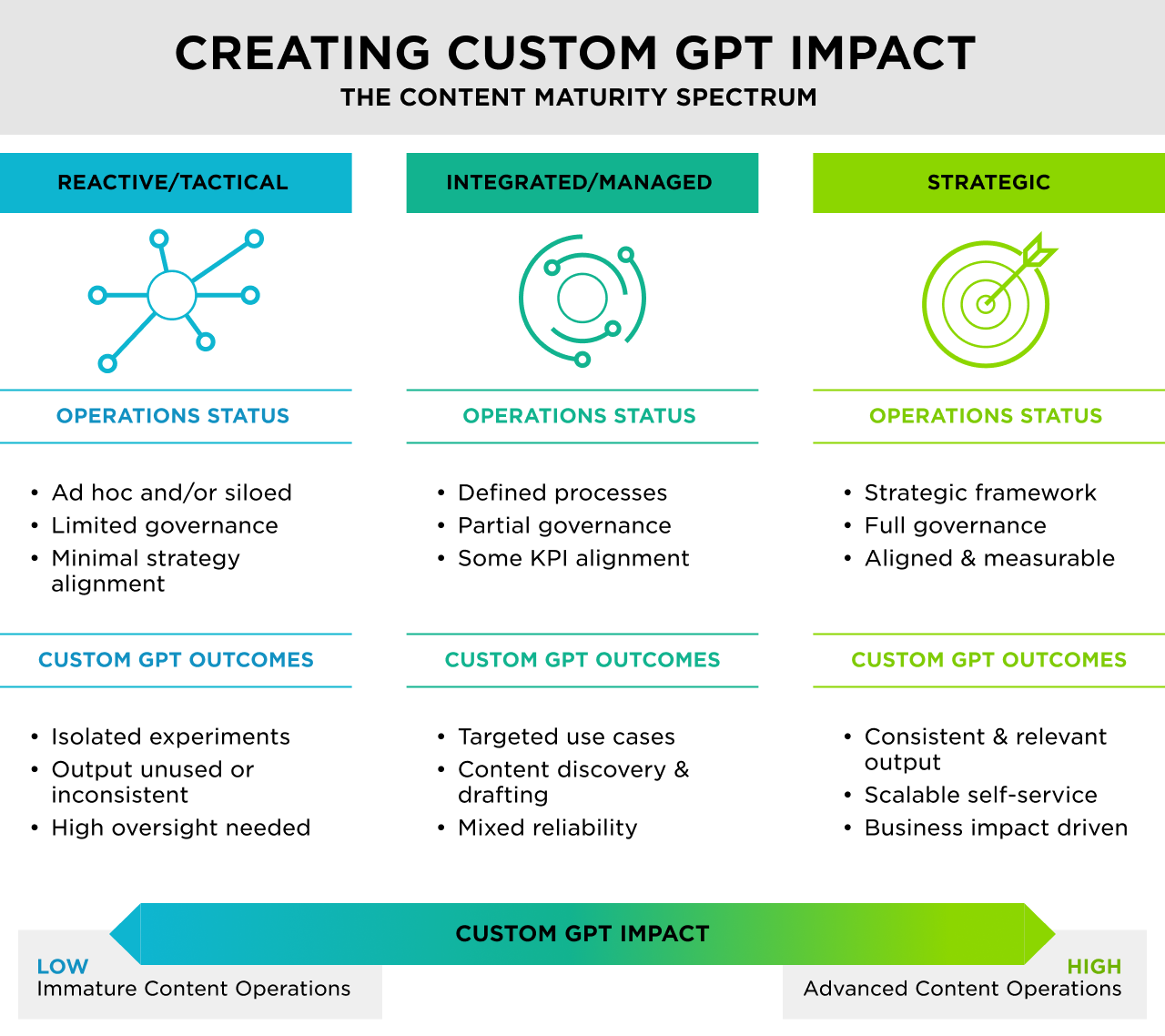
Early Maturity (Reactive/Tactical): When GPT Output Has Nowhere to Go
What content operations look like:
- Content handled ad hoc or in silos
- Limited role clarity or governance
- Minimal linkage between content and business outcomes
What this means for custom GPTs:
At this stage, GPT outputs may be technically usable, but they lack:
- Clear destinations in the content ecosystem
- Defined workflows for review, deployment, or reuse
- Measurement models to assess impact
AI introduces velocity without direction. Instead of reducing effort, it often increases coordination overhead as teams scramble to figure out what to do with the output.
Mid Maturity (Integrated/Managed): Where GPTs Help But Expose Friction
What content operations look like:
- Defined publishing and maintenance processes
- Emerging governance and role clarity
- Partial alignment to audience journeys and KPIs
What GPTs can support:
- Faster drafting and adaptation
- Improved internal enablement
- Better content discovery and reuse
Where constraints show up:
As GPT usage expands, gaps become harder to ignore:
- Inconsistent content models limit reuse
- Governance doesn’t extend across the full lifecycle
- Optimization feedback loops are underdeveloped
AI starts to surface the limits of the system, not because it’s failing but because it’s operating at scale.
High Maturity (Strategic): When GPT Output Reinforces Business Results
What content operations look like:
- Content treated as strategic infrastructure
- Clear operating models, ownership, and governance
- Optimization tied directly to audience and business outcomes
What changes at this level:
- GPT outputs align to strategy by default
- Deployment paths are defined
- Measurement connects activity to impact
Here, AI doesn’t replace strategy or operations. It executes within them. That’s when custom GPTs begin to reinforce trust, consistency, and performance.
Conclusion: AI Scales What You’ve Already Built
Custom GPTs can absolutely accelerate marketing, but only within the context of the content operations that surround them. Brand guardrails shape how AI output looks and sounds. Content maturity guardrails determine whether it drives results.
The organizations that realize real value from AI won’t be the fastest to deploy. They’ll be the most prepared to absorb, govern, and operationalize what AI produces.
Not sure where your content operations stand?
Assess your organization’s content maturity and identify the guardrails AI needs to succeed.