



In our many years working with enterprise marketing teams, Tendo has seen more and more organizations invest in headless content management systems (CMS) to modernize their digital experiences. We applaud this trend because migrating to a platform like Contentful, Contentstack, or Sanity can enable an enterprise to produce content faster, establish consistency across touchpoints, and scale personalization and localization—all key attributes of mature digital marketing organizations.
More often than not, teams migrate their content page by page, carrying the old structure into the new platform. A few months—or even a few years—later, those same teams are still authoring content page by page, which we do not applaud. The CMS may be headless, but their page-based approach persists.
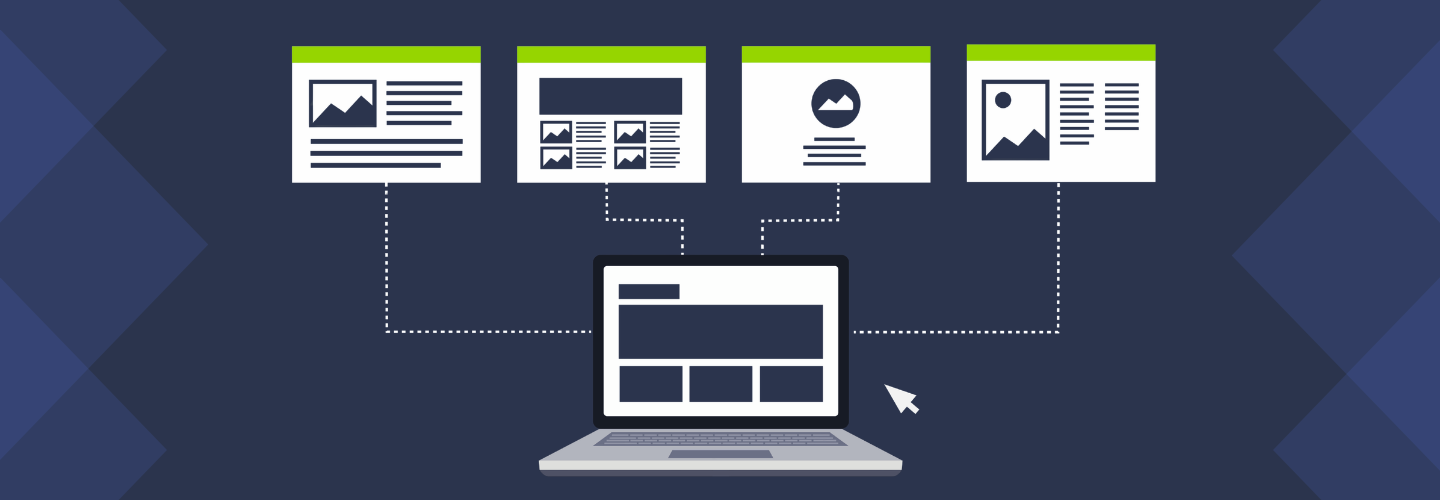
Headless CMS platforms aren’t designed to manage “pages.” They’re built for modular, reusable content that can be assembled across channels. Done right, a single piece of content can power dozens of experiences.
Most teams understand this in theory, but in practice, they still tend to:
- Create content for a single page or layout
- Duplicate or recreate content when it’s needed on another page or channel
- Model content types around pages instead of meaning
As a result, organizations invest in these platforms without fundamentally changing how content operates, squandering the main value proposition of their chosen platform.
The Relationship Between Headless and Structured Content
The platform and the strategy are related, but they are not the same. A headless CMS doesn’t come with a preinstalled content strategy for best results.
Headless CMS platforms separate content (the words and information) from presentation (how it looks). Content lives in a central repository, from which any channel can pull what it needs. We covered the basics in Rethink Your Content Strategy for a Headless CMS.
Structured content as a strategy is what makes the platform effective, and you can implement it in increasing levels of sophistication based on your needs and capacity. At a basic level, it might mean consistently defining elements like headings, metadata, taxonomy, and content types. More advanced approaches connect content through structured relationships and contextual data so it can adapt across channels and experiences.
The content is authored in one place and assembled differently depending on the experience. Structured content defines the individual elements; a page layout simply determines how those elements are presented.
The key is defining what each piece actually is. This is where your content model plays a pivotal role. If your model is built around layout—hero, body, sidebar, three cards—you’re structuring presentation, not content. If it’s based on meaning—a product, feature, testimonial, or support answer—you’re structuring content. When each piece has a clear purpose, it can appear in multiple contexts without being recreated.
Our podcast episode on The Benefits of Structured Content digs into this approach in more detail.
Page-Based Thinking Is Holding You Back
Most teams treat a headless CMS like a traditional one: building content “pages” that mirror the website and accounting for layout while writing. There are a few reasons this happens.
Resorting to legacy content models
Headless CMS platforms are intentionally flexible. That flexibility is part of their value, but it also leaves teams to define their own content models. Without a clear strategy, teams fall back on what they know: pages.
Implementation without content team input
Implementation approaches often reinforce the problem. Headless rollouts are typically led by engineering teams, with content teams brought in late or not at all. The platform gets configured to deliver a website rather than support long-term content operations. Content teams need to be involved from the start, so the model reflects how content is actually created, used, and managed.
Lift-and-shift instead of rethinking content
In many cases, migration keeps existing content patterns in place. Content is often lifted-and-shifted from a legacy CMS with the same page structures intact. Migrations are sometimes treated as an opportunity to rethink information architecture, but rarely as an opportunity to rethink how content itself is modeled.
Lax content governance
Organizational dynamics are also a factor. Over the past decade, many enterprises have moved toward self-service publishing, with page ownership distributed across teams. That works reasonably well in traditional CMS platforms where each page exists as its own object. But headless CMS platforms make content more reusable and interconnected, which increases the need for centralized governance.
You’re likely not getting the full value from your CMS if:
- The same information exists in multiple places with slight variations
- Reuse is manual and inconsistent
- New pages and channels require net-new content creation
The platform itself usually isn’t the problem. The issue is how content is modeled inside it.
This also isn’t unique to headless CMS platforms, even if the gap is more obvious there. Traditional platforms like Adobe Experience Manager (AEM) support structured content through content fragments, metadata, component governance, and APIs for content delivery. If you’re waiting for a headless migration to address content structure, you may be waiting longer than necessary. The mindset shift can happen independently of the platform.
Building Structured Content: Where to Start
The good news is that you don’t need to restructure everything at once. In a few steps, you can start building structured content to get more value from your headless CMS:
- Select one or two high-priority content types.
- Define them based on meaning rather than layout.
- Map how they relate to other content.
- Establish the fields and attributes they need.
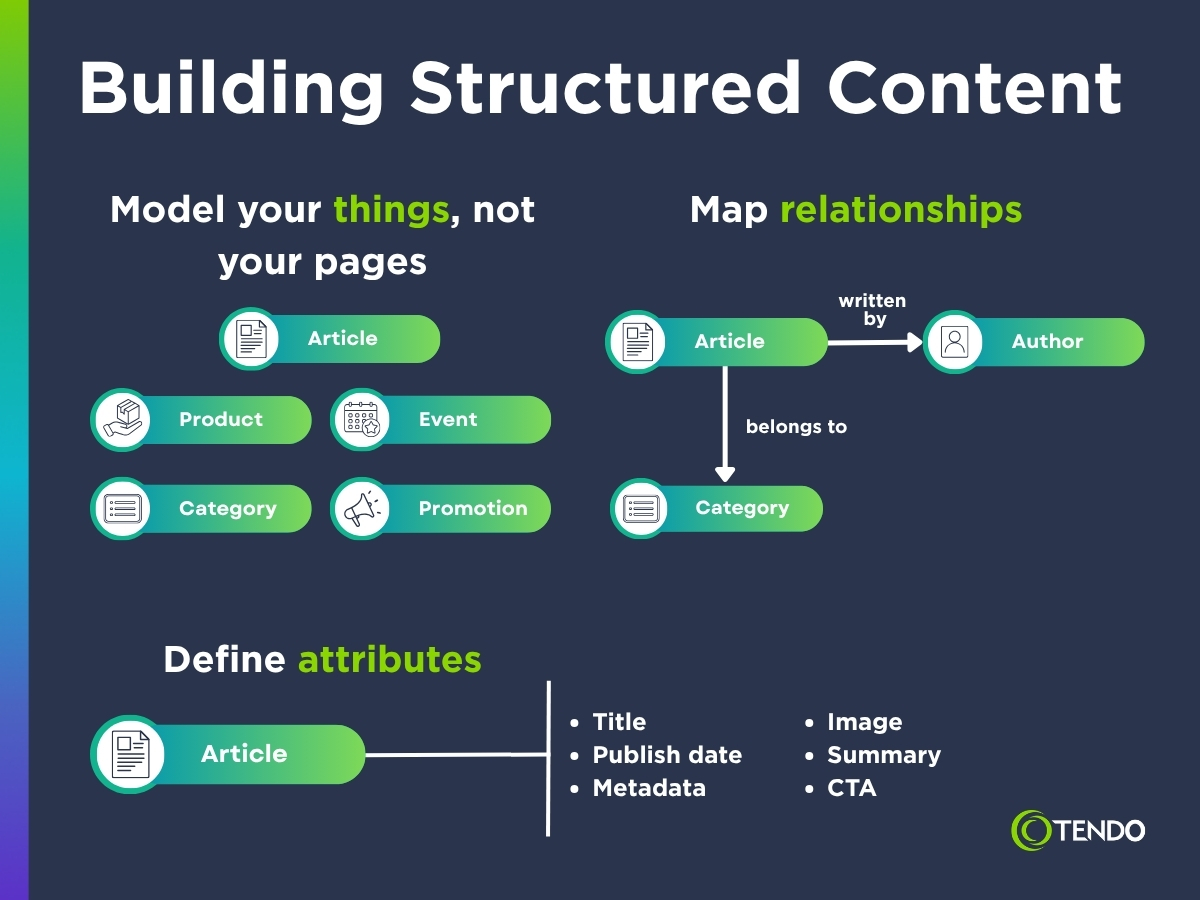
An article is a good content type to start with—remember that in the headless model the article is a content type and not a page. To refactor it as structured content, model the article as a reusable content object and specify its required information:
- title
- summary
- image
- publish date
- author
- CTA
- related metadata
Depending on what information is pulled into a given channel, that same article might appear on its own detail page, in a grid of recent posts, in a featured banner on the homepage, in a newsletter, in a LinkedIn post, and ideally as a citation in an AI tool.
If you’re working with large volumes of page-based content created over years, a full shift to structured content won’t happen overnight. Many organizations end up with a mix of structured and unstructured content. You may not need to do deep modeling for some content, like campaign landing pages, because the page itself is the experience. Even then, though, you can still structure reusable elements such as headlines, data points, and form fields consistently.
Where Structured Content Pays Off in the AI Era
For years, the value of structured content was primarily operational: less duplication, more consistency, and easier distribution across channels. That still matters, and AI is raising the stakes by changing how content is discovered, interpreted, and surfaced.
AI tools don’t navigate websites the way people do, skimming and scrolling and interpreting visual hierarchy. Instead, they look for specific pieces of information that can be extracted and incorporated into generated responses. Websites are more or less becoming databases for AI crawlers.
When content is loosely structured or tightly tied to pages, that database breaks down. Key information gets buried in large rich-text fields. Context is implied instead of being explicit. Similar concepts show up across multiple pages with slightly different wording. All of this makes it harder for AI tools to reliably identify and surface your content.
When content is structured around meaning, the opposite is true. Information is discrete and easier to extract. Relationships between content types are clearer. Content stays consistent across pages and channels.
AEO and GEO — the practices behind getting your content surfaced and cited by conversational AI tools and AI overviews — work better when content is structured. Structured content has effectively become a prerequisite for AI visibility.
The cleaner and more organized your content is, the easier it is for both AI tools and people to find and understand it.
This is where it pays to be specific. Prioritize areas like:
- Product information that should stay consistent across websites, apps, sales materials, and AI responses
- Help and support content that powers chatbots, search, knowledge bases, and in-product guidance
- Reference content like FAQs, glossaries, and policies that AI tools are likely to cite
- Marketing messaging, proof points, and value propositions reused across pages, campaigns, and channels
Don’t embed high-value content like this inside images or long blocks of text. If it’s worth the time to plan, write, and review, it’s worth structuring so it can be found, reused, and surfaced effectively.
The Promise of a Headless CMS is Real. Structured Content Delivers It.
A headless CMS makes flexibility possible, but you won’t realize the value of that flexibility without structured content. Even the legacy content platforms have come around to the fact that their full potential is tied to how content is modeled and managed, and ultimately, to how organizations think about content in the first place. If your content model is still stuck in page-based thinking, it won’t support content being read, retrieved, reused, and recombined across experiences. A headless CMS alone won’t make that happen.
Ready to get more from your headless investment?
Tendo’s content strategists help B2B and enterprise brands build content models, assess AI-readiness, and improve content operations. Let’s talk.