



The modern B2B buyer arrives at an enterprise website with an informed idea of how the brand can help resolve their business challenges. They’ve done all their self-directed, AI-assisted research and expect the site to reflect an understanding of their needs.
A site that fails to meet that expectation can alienate the buyer, who might assume the vendor just doesn’t get their business. According to Forrester research, 92% of B2B buyers already have a vendor in mind before evaluation even starts, meaning a bad first impression could be the buyer’s last visit. They can just as easily abandon the site and move on to the next vendor on their shortlist.
Based on years of enterprise engagements, Tendo has seen three patterns that sabotage a site’s ability to build trust with a buyer: fragmented messaging, narratives that speak the company’s language instead of the buyer’s, and personalized experiences that stop at a persona level instead of the individual. They all trace back to gaps in content strategy, information architecture, and personalization strategy.
Fragmented Messaging Across the Website
When an enterprise buyer navigates from a piece of thought leadership to a product page to a case study, they’re likely to come across variations in messaging. Different teams typically own each of those pieces, from content marketing to product marketing to brand or corporate marketing. Every team does careful work within its own remit, but without a shared strategy connecting those efforts, small inconsistencies can compound as the buyer moves from one team’s content into another’s.
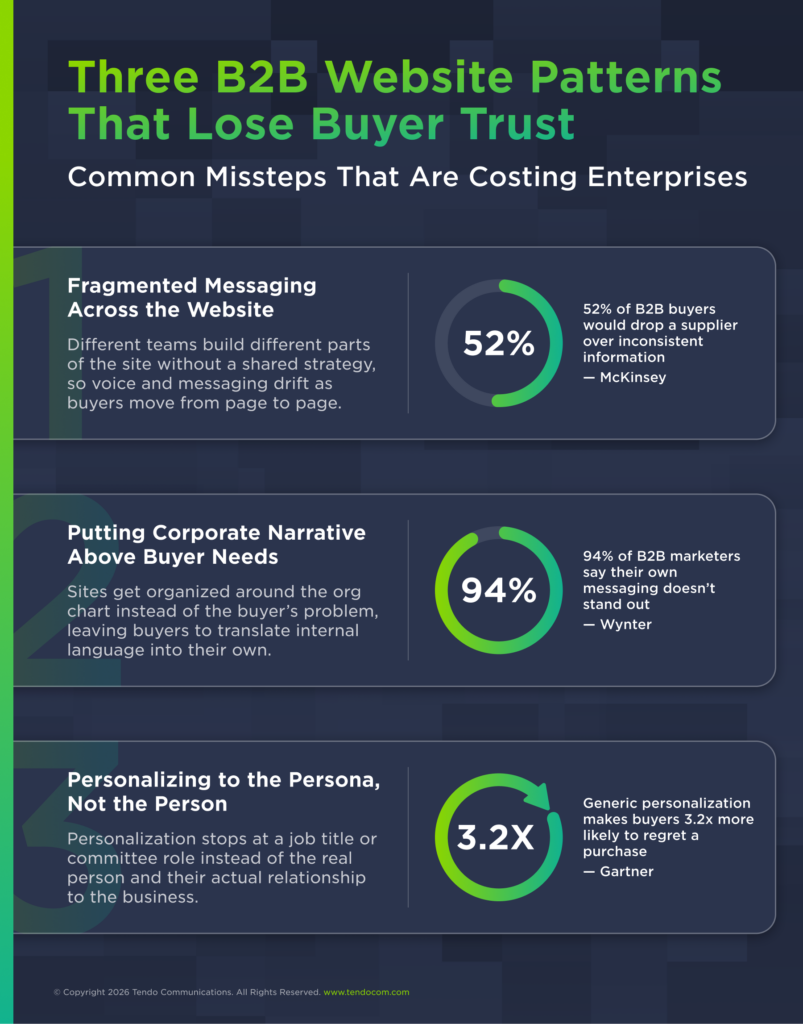
The root cause is a structural hurdle. The Content Marketing Institute’s 2026 benchmarking research finds cross-department collaboration among B2B marketers’ top three content marketing challenges, cited by 21% of respondents. The misaligned messaging that can result from siloed departments has a measurable risk. According to McKinsey’s The Surprising Economics of B2B Growth (May 2026), 52% of B2B buyers would stop working with a supplier whose internal teams give inconsistent information.
52% of B2B buyers would stop working with a supplier whose internal teams give inconsistent information.
3M ran into a version of this at enterprise scale. A case study on the company’s effort to break down organizational silos describes fragmented data touchpoints and inconsistent customer experiences across its business groups. The fragmentation was resolved only once data and content decisions were unified across teams.
Closing that gap starts with bringing a site’s content under one strategy instead of several parallel ones and keeping it that way as teams continue publishing through ongoing content governance.
Putting Corporate Narrative Above Buyer Needs
Enterprises can fall into the trap of describing their solutions based on how the organization understands itself. They allow internal product phrasing and business unit terminology to leak through to customer-facing content. That language is often precise and hard-won. It is also frequently not the language the buyer uses to describe their own problems, concerns, and priorities.
On the website, this shows up in navigation and information architecture. Sites organized by product line or business unit usually reflect how the organization manages ownership and accountability internally, a reasonable structure for running the business. That structure rarely matches the customer’s problem-solving path, though, and it forces them to translate the company’s internal language into their own before they can even evaluate fit.
Consider a common setup: products and solutions grouped by business unit, each driving traffic to content framed around its own product and the narrow problem it solves. When the buyer’s problem spans more than one unit, the site’s structure doesn’t quite meet them there.
B2B marketing leaders recognize this gap in their own messaging. According to Wynter’s B2B SaaS Branding Is Stuck research, 94% admit their messaging does not stand out, and only 6% call it truly distinctive, with 14% tracing the miss specifically to being disconnected from customer reality.
A card sorting exercise can help enterprises assess how buyers define their needs and goals. They can then carry that structure into a content strategy, information architecture, and taxonomy that organize the site around the buyer’s problem rather than which business unit happens to sell the corresponding product.
Personalizing to the Persona, Not the Person
Persona and role in buying committee are useful personalization signals. But they are only two of many attributes that shape what will resonate with the person behind the screen, including something as basic as their existing relationship with the business.
Consider two visitors who share the same persona and the same committee role: a prospect evaluating vendors for the first time, and a buyer at a company that already uses the product. Personalized to the persona, both see the same demo pitch. The existing customer is not shopping, though. They need post-sales support or an integrated solution, not an invitation to a sales conversation they already had. Personalizing to the persona alone cannot tell these two people apart. Personalizing to the person can.
Most enterprises already have the personalization tooling and the underlying data to do this. What’s missing is the strategy: deciding which attributes and behaviors should change the experience, streamlining the data that identifies them, and structuring content so execution is possible. Absent that strategy, personalization defaults to an available proxy such as the persona or committee-role bucket.
Settling for that proxy can lead to dissatisfied buyers. Gartner found that passive, generic personalization made buyers 3.2x more likely to regret their purchases, with 53% of buyers reporting some negative effect from personalization overall. Effective personalization is built on structured content flexible enough to assemble an individual experience; ongoing A/B testing keeps it optimized over time.
Passive, generic personalization made buyers 3.2x more likely to regret their purchases
Reinforcing Buyer Trust Starts With the Site Itself
Every one of these patterns starts in the same place: a website built around how the company understands itself, not around how the buyer experiences their own problem. The org chart shapes the navigation. Internal narratives shape the messaging. The available data shapes personalization. The buyer, meanwhile, experiences a site that falls short of the standard they set from their research.
That standard is not forgiving, and it is not going away. Buyers are only getting more capable of doing this research on their own, and less patient with a site that makes them do the translating. Reinforcing trust on the site comes down to the three disciplines underpinning each pattern: content strategy grounded in the buyer’s needs, information architecture built around their problem instead of the org chart, and personalization precise enough to treat them as a person, not a persona.
Get those right, and the website stops being something the sales team has to talk around. It becomes proof that this vendor already understands the visitor’s business needs and goals.